
styled-text

NOW APPROVED

text-color-black
hero-secondary
A ship breaks through icebergs that reflect the many challenges in treating mPDAC and targeting RAS.

Unmet need in PDAC

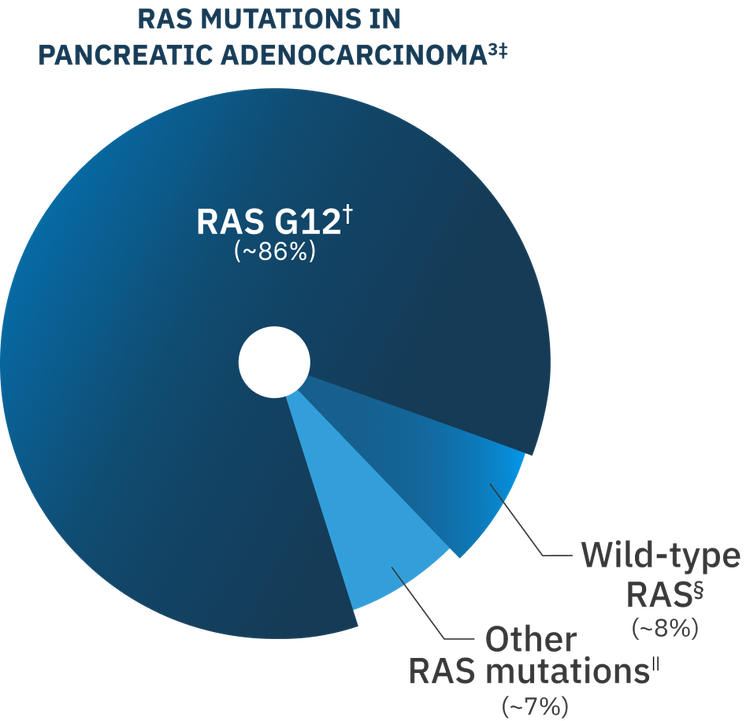
Metastatic pancreatic adenocarcinoma remains one of the deadliest cancers. RAS(ON) is a key oncogenic driver, with RAS mutations present in ~93% of all pancreatic adenocarcinoma.1-3

spacing-xl
styled-text

For almost 3 decades, the metastatic pancreatic adenocarcinoma treatment landscape has remained effectively unchanged4,5

text-color-denim-blue
styled-text
  • Pancreatic cancer is the third-leading cause of cancer death in the United States1

margin-top-lg
margin-bottom-lg
text-color-black
styled-text
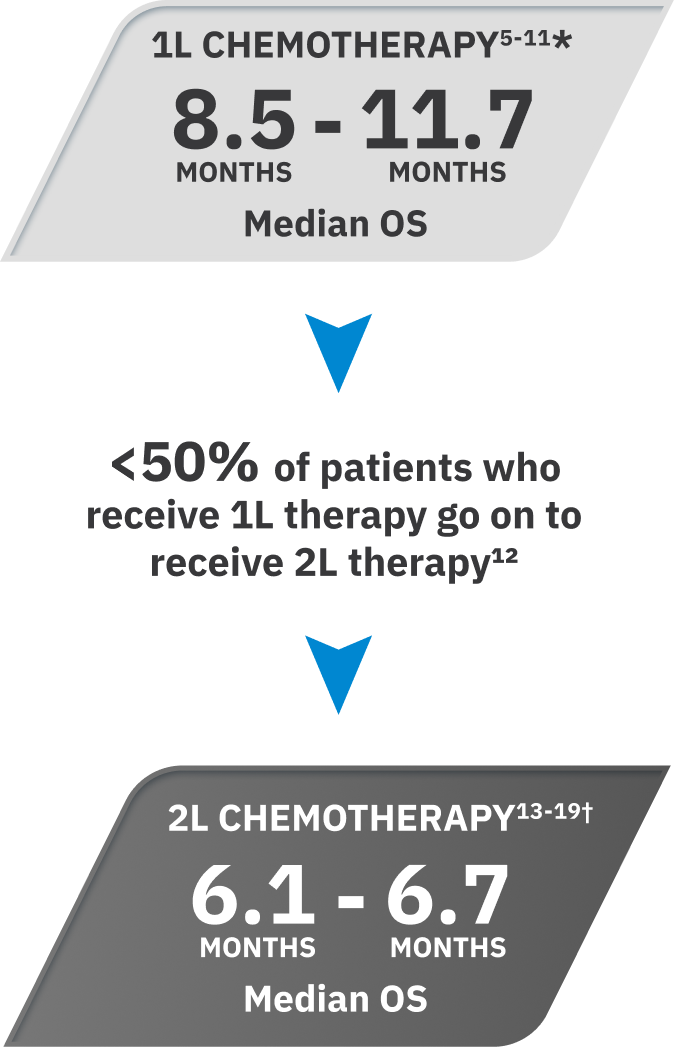
Metastatic pancreatic adenocarcinoma is primarily treated with chemotherapy, which often offers limited clinical benefit2

margin-top-none
margin-bottom-sm
text-color-denim-blue
graphic
Range of median OS in 1L chemotherapy5-11*: 8.5 months to 11.7 months. Less than 50% of patients who receive 1L therapy go on to receive 2L therapy12. Range of median OS in 2L chemotherapy13-19†: 6.1 months to 6.7 months.
spacing-md
callout-banner
without-image
Metastatic pancreatic adenocarcinoma has a 5-year survival rate of only 3%20
background-color
gradient-denim-cobalt
styled-text

For almost 3 decades, the metastatic pancreatic adenocarcinoma treatment landscape has remained effectively unchanged

styled-text
text-color-denim-blue
styled-text

*1L chemotherapy treatments included gemcitabine + nab-paclitaxel, NALIRIFOX, and FOLFIRINOX.5-11

2L chemotherapy treatments included FOLFOX, FOLFIRI, gemcitabine + nab-paclitaxel, mFOLFOX, paclitaxel + gemcitabine, and 5-FU + leucovorin + nanoliposomal irinotecan.13-19

margin-top-sm
mobile-margin-top-none
text-color-90-black
styled-text

~93% of all pancreatic adenocarcinoma is driven by RAS mutations3*

margin-top-lg
margin-bottom-lg
mobile-margin-top-20
mobile-margin-bottom-10
text-color-denim-blue
fit
true
l
center
start
false
styled-text
RAS mutations are heterogeneous21
  • The most common RAS mutations in pancreatic adenocarcinoma include KRAS G12 variants
RAS(ON) proteins are the key oncogenic driver of pancreatic adenocarcinoma2
  • RAS(ON), the active form of RAS, accumulates due to RAS mutations, driving uncontrolled cell growth and proliferation22-24
  • RAS(OFF) is the inactive form of RAS and is non-oncogenic25,26
styled-text, type-list-item-double-arrow-blue, type-list-item-double-arrow-90-black
text-color-denim-blue
graphic
RAS mutations in pancreatic adenocarcinoma^3 double dagger: RAS G12 dagger (~86%), Wild-type RAS section mark (~8%), Other RAS mutations^parallel lines (~7%).
styled-text

*As determined by NGS tissue-based tests.3

Includes KRAS G12D (~40%), G12V (~29%), and G12R (~15%) mutations.3

The total percent of RAS mutations and wild-type RAS may not equal 100% due to rounding.

§Defined as samples lacking RAS mutations at positions G12, G13, and Q61, as determined by NGS tissue-based tests.3

||Includes NRAS and HRAS mutations, as well as non-G12 KRAS mutations.3

margin-top-lg
margin-bottom-lg
mobile-margin-top-10
text-color-90-black
callout-banner
without-image
A RAS(ON) multi-selective targeted treatment could significantly impact patients with metastatic pancreatic adenocarcinoma3,21
background-color
gradient-denim-cobalt
styled-text

For almost 3 decades, the metastatic pancreatic adenocarcinoma treatment landscape has remained effectively unchanged

styled-text
text-color-denim-blue

See the data

spacing-xl
spacing-sm
mobile-spacing-sm
styled-text
1L=first-line; 2L=second-line; 5-FU=5-fluorouracil; FOLFIRI=leucovorin + 5-FU + irinotecan; FOLFIRINOX=leucovorin + 5-FU + irinotecan + oxaliplatin; FOLFOX=leucovorin + 5-FU + oxaliplatin; HRAS=Harvey rat sarcoma; KRAS=Kirsten rat sarcoma; mFOLFOX=modified leucovorin + 5-FU + oxaliplatin; mPDAC=metastatic pancreatic adenocarcinoma; NALIRIFOX=liposomal irinotecan + leucovorin + 5-FU + oxaliplatin; NGS=next-generation sequencing; NRAS=neuroblastoma rat sarcoma; OS=overall survival; PDAC=pancreatic adenocarcinoma; RAS=rat sarcoma.
margin-top-none
margin-bottom-none
mobile-margin-top-none
text-color-90-black
spacing-lg
mobile-spacing-lg
styled-text
References: 1. Cancer stat facts: pancreatic cancer. National Cancer Institute Surveillance, Epidemiology, and End Results Program. Accessed June 10, 2026. https://seer.cancer.gov/statfacts/html/pancreas.html 2. O’Reilly EM, Wainberg ZA, Hendifar AE, et al; RASolute 302 Trial Investigators. Daraxonrasib or chemotherapy in previously treated metastatic pancreatic cancer. N Engl J Med. Published online May 31, 2026. doi:10.1056/NEJMoa2605555 3. Pant S, Ahler E, Kar S, Lin KK. Prevalence of oncogenic RAS mutations in patients with metastatic pancreatic ductal adenocarcinoma (PDAC) derived from the real-world evidence database FoundationCORE. Poster presented at: ASCO Gastrointestinal Cancers Symposium; January 23-25, 2025; San Francisco, CA. 4. Katayama ES, Hue JJ, Bajor DL, et al. A comprehensive analysis of clinical trials in pancreatic cancer: what is coming down the pike? Oncotarget. 2020;11(38):3489-3501. doi:10.18632/oncotarget.27727 5. Wainberg ZA, Melisi D, Macarulla T, et al. NALIRIFOX versus nab-paclitaxel and gemcitabine in treatment-naive patients with metastatic pancreatic ductal adenocarcinoma (NAPOLI 3): a randomised, open-label, phase 3 trial. Lancet. 2023;402(10409):1272-1281. doi:10.1016/S0140-6736(23)01366-1 6. Von Hoff DD, Ervin T, Arena FP, et al. Increased survival in pancreatic cancer with nab-paclitaxel plus gemcitabine. N Engl J Med. 2013;369(18):1691-1703. doi:10.1056/NEJMoa1304369 7. Conroy T, Desseigne F, Ychou M, et al; Groupe Tumeurs Digestives of Unicancer; PRODIGE Intergroup. FOLFIRINOX versus gemcitabine for metastatic pancreatic cancer. N Engl J Med. 2011;364(19):1817-1825. doi:10.1056/NEJMoa1011923 8. Philip PA, Sahai V, Bahary N, et al. Devimistat (CPI-613) with modified fluorouarcil, oxaliplatin, irinotecan, and leucovorin (FFX) versus FFX for patients with metastatic adenocarcinoma of the pancreas: the phase III AVENGER 500 study. J Clin Oncol. 2024;42(31):3692-3701. doi:10.1200/JCO.23.02659 9. Tempero M, Oh D-Y, Tabernero J, et al. Ibrutinib in combination with nab-paclitaxel and gemcitabine for first-line treatment of patients with metastatic pancreatic adenocarcinoma: phase III RESOLVE study. Ann Oncol. 2021;32(5):600-608. doi:10.1016/j.annonc.2021.01.070 10. Bekaii-Saab T, Okusaka T, Goldstein D, et al. Napabucasin plus nab-paclitaxel with gemcitabine versus nab-paclitaxel with gemcitabine in previously untreated metastatic pancreatic adenocarcinoma: an adaptive multicentre, randomised, open-label, phase 3, superiority trial. EClinicalMedicine. 2023;58:101897. doi:10.1016/j.eclinm.2023.101897 11. Van Cutsem E, Tempero MA, Sigal D, et al; HALO 109-301 Investigators. Randomized phase III trial of pegvorhyaluronidase alfa with nab-paclitaxel plus gemcitabine for patients with hyaluronan-high metastatic pancreatic adenocarcinoma. J Clin Oncol. 2020;38(27):3185-3196. doi:10.1200/JCO.20.00590 12. King G, Ittershagen S, He L, Shen Y, Li F, Villacorta R. Treatment patterns in US patients receiving first-line and second-line therapy for metastatic pancreatic ductal adenocarcinoma in the real world. Adv Ther. 2022;39(12):5433-5452. doi:10.1007/s12325-022-02317-9 13. Chung V, McDonough S, Philip PA, et al. Effect of selumetinib and MK-2206 vs oxaliplatin and fluorouracil in patients with metastatic pancreatic cancer after prior therapy: SWOG S1115 study randomized clinical trial. JAMA Oncol. 2017;3(4):516-522. doi:10.1001/jamaoncol.2016.5383 14. Hecht JR, Lonardi S, Bendell J, et al. Randomized phase III study of FOLFOX alone or with pegilodecakin as second-line therapy in patients with metastatic pancreatic cancer that progressed after gemcitabine (SEQUOIA). J Clin Oncol. 2021;39(10):1108-1118. doi:10.1200/JCO.20.02232 15. Huffman BM, Basu Mallick A, Horick NK, et al. Effect of a MUC5AC antibody (NPC-1C) administered with second-line gemcitabine and nab-paclitaxel on the survival of patients with advanced pancreatic ductal adenocarcinoma: a randomized clinical trial. JAMA Netw Open. 2023;6(1):e2249720. doi:10.1001/jamanetworkopen.2022.49720 16. Chiorean EG, Guthrie KA, Philip PA, et al. Randomized phase II study of PARP inhibitor ABT-888 (veliparib) with modified FOLFIRI versus FOLFIRI as second-line treatment of metastatic pancreatic cancer: SWOG S1513. Clin Cancer Res. 2021;27(23):6314-6322. doi:10.1158/1078-0432.CCR-21-1789 17. Wang-Gillam A, Li C-P, Bodoky G, et al; NAPOLI-1 Study Group. Nanoliposomal irinotecan with fluorouracil and folinic acid in metastatic pancreatic cancer after previous gemcitabine-based therapy (NAPOLI-1): a global, randomised, open-label, phase 3 trial. Lancet. 2016;387(10018):545-557. doi:10.1016/S0140-6736(15)00986-1 18. De La Fouchardière C, Malka D, Cropet C, et al. Gemcitabine and paclitaxel versus gemcitabine alone after 5-fluorouracil, oxaliplatin, and irinotecan in metastatic pancreatic adenocarcinoma: a randomized phase III PRODIGE 65-UCGI 36-GEMPAX UNICANCER study. J Clin Oncol. 2024;42(9):1055-1066. doi:10.1200/JCO.23.00795 19. Hammel P, Metges J-P, Mercade TM, et al. TRYBECA-1: a randomized phase III study of eryaspase combined with chemotherapy versus chemotherapy as second-line treatment in patients with advanced pancreatic adenocarcinoma. J Clin Oncol. 2025;43(35):3714-3727. doi:10.1200/JCO-25-00872 20. American Cancer Society. Cancer Facts & Figures 2026. Atlanta: American Cancer Society; 2026. https://www.cancer.org/content/dam/cancer-org/research/cancer-facts-and-statistics/annual-cancer-facts-and-figures/2026/2026-cancer-facts-and-figures.pdf 21. Der CJ, Yeh JJ. Advances in RAS therapeutics for pancreatic cancer. N Engl J Med. 2026;394(18):1857-1861. doi:10.1056/NEJMe2600517 22. Cregg J, Edwards AV, Chang S, et al. Discovery of daraxonrasib (RMC-6236), a potent and orally bioavailable RAS(ON) multi-selective, noncovalent tri-complex inhibitor for the treatment of patients with multiple RAS-addicted cancers. J Med Chem. 2025;68(6):6064-6083. doi:10.1021/acs.jmedchem.4c02314 23. Jiang J, Jiang L, Maldonato BJ, et al. Translational and therapeutic evaluation of RAS-GTP inhibition by RMC-6236 in RAS-driven cancers. Cancer Discov. 2024;14(6):OF1-OF24. doi:10.1158/2159-8290.CD-24-0027 24. Bahar ME, Kim HJ, Kim DR. Targeting the RAS/RAF/MAPK pathway for cancer therapy: from mechanism to clinical studies. Signal Transduct Target Ther. 2023;8(1):455. doi:10.1038/s41392-023-01705-z 25. Waters AM, Der CJ. KRAS: the critical driver and therapeutic target for pancreatic cancer. Cold Spring Harb Perspect Med. 2018;8(9):a031435. doi:10.1101/cshperspect.a031435 26. Zhou Y, Hancock JF. Ras nanoclusters: versatile lipid-based signaling platforms. Biochim Biophys Acta. 2015;1853(4):841-849. doi:10.1016/j.bbamcr.2014.09.008
margin-top-none
margin-bottom-none
text-color-90-black
spacing-xl
mobile-spacing-xl