
NOW APPROVED

hero-secondary
A ship breaks through icebergs that reflect the many challenges in treating mPDAC and targeting RAS.

Efficacy

RASONQUE demonstrated unprecedented improvements in OS and PFS vs SOC combination chemotherapy.1,2

spacing-xl
styled-text
In RASolute 302
margin-top-none
margin-bottom-sm
text-color-denim-blue
styled-text

Unprecedented overall survival (OS) was observed in patients, regardless of RAS mutation status1,2

margin-bottom-sm
mobile-margin-bottom-30
text-color-corazon
styled-text
Primary endpoints1,3
margin-bottom-none
text-color-denim-blue
OS
(RAS G12 POPULATION)
RASONQUE
(n=228)
SOC combination chemotherapy*
(n=231)
mOS
13.2 months
6.6 months
HR=0.40 (95% CI: 0.30, 0.54); p<0.0001
PFS
(RAS G12 POPULATION)
RASONQUE
(n=228)
SOC combination chemotherapy*
(n=231)
mPFS
7.3 months
3.5 months
HR=0.45 (95% CI: 0.34, 0.59); p<0.0001
spacing-md
Secondary endpoint
OS (ITT POPULATION)1
OS was a secondary endpoint 1 in the ITT population: 13.2 months median OS with RASONQUE (95% CI: 10.0, NE) versus 6.7 months median OS with SOC combination chemotherapy (95% CI: 5.8, 8.0). 60% reduction in the risk of death (HR=0.40 [95% CI: 0.30, 0.53]^dagger; p&lt;0.0001^double dagger).
HR=0.40 (95% CI: 0.30, 0.53); p<0.0001
PINCH AND ZOOM
styled-text
More than half of patients receiving RASONQUE were still alive at 12 months
margin-top-md
margin-bottom-lg
mobile-margin-bottom-25
text-color-denim-blue
callout-banner
without-image
The longest mOS observed in a Phase 3 metastatic pancreatic adenocarcinoma trial1,3-14||
background-color
gradient
styled-text

In the ITT population, 105 patients (42.3%) continued to receive RASONQUE and 35 (13.9%) continued to receive SOC combination chemotherapy at the time of data cutoff (February 10, 2026).3

*SOC combination chemotherapy included mFOLFIRINOX, gemcitabine + nab-paclitaxel, FOLFOX, or liposomal irinotecan + 5-FU/leucovorin.1

Based on the stratified Cox proportional hazard model.1

Two-sided p-value based on stratified log-rank test.1,3

§The 12-month OS was 53.2% in the RASONQUE group and 17.3% in the SOC combination chemotherapy group.3

||As of May 31, 2026.3

margin-top-sm
margin-bottom-none
mobile-margin-top-5
text-color-90-black
spacing-xl
spacing-xl
styled-text
Additional data from RASolute 302
margin-bottom-sm
text-color-denim-blue
styled-text

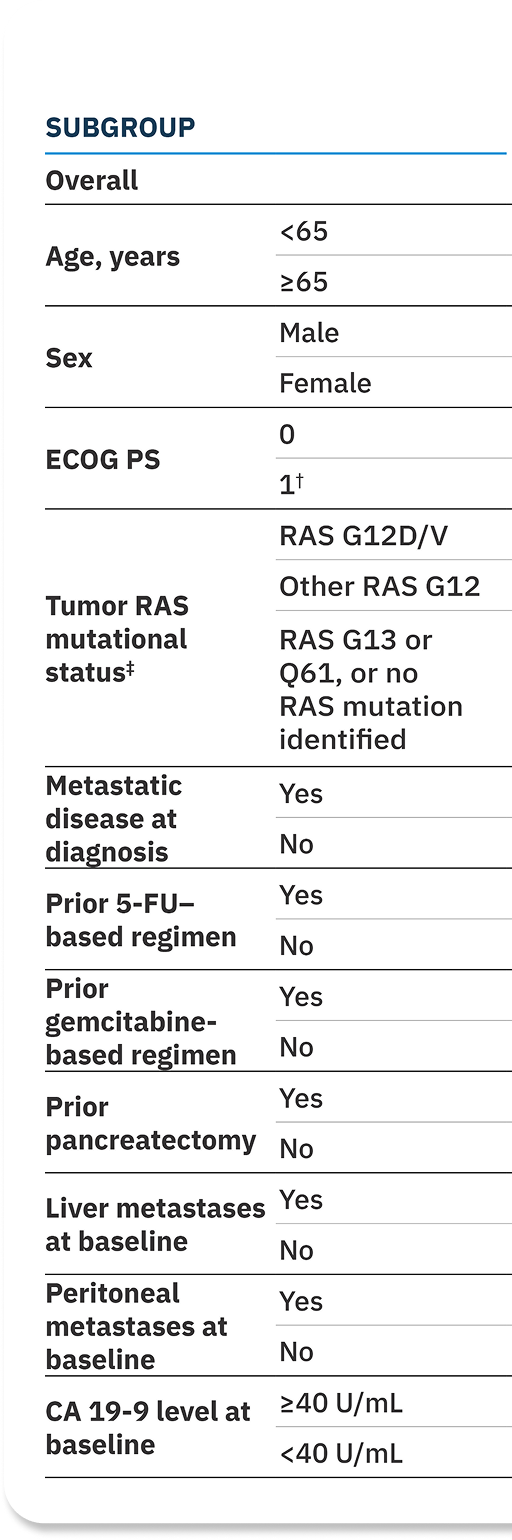
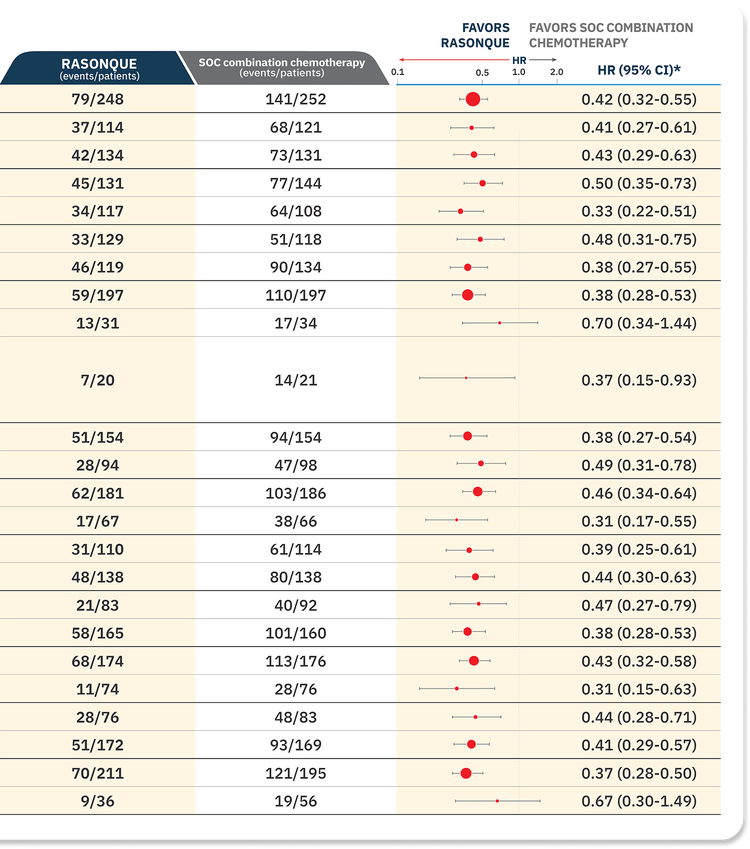
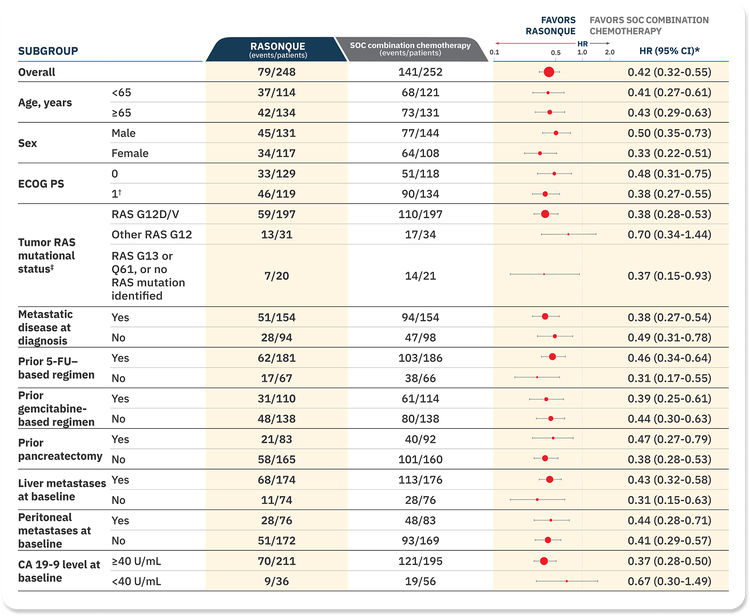
OS results across prespecified subgroups15
margin-bottom-sm
text-color-corazon
styled-text
OS analysis by subgroup was not evaluated for statistical significance. Small patient numbers can be a limitation of subgroup analyses. These analyses are provided as descriptive clinical information only.
margin-top-md
margin-bottom-lg
mobile-margin-top-10
mobile-margin-bottom-10
text-color-90-black
Additional data from RASolute 302: Forest plot of OS results across prespecified subgroups.
SLIDE TO SEE MORE
styled-text
The size of circles is relative to the size of the population in each subgroup.
margin-bottom-md
mobile-margin-bottom-20
text-color-90-black
styled-text

*HRs and 95% CIs were based on the unstratified Cox model with Efron’s method of tie handling.15

Three patients (including 2 patients randomized to the RASONQUE arm and 1 patient randomized to the chemotherapy arm) had ECOG PS >1 at baseline. These patients were not dosed due to no longer meeting trial eligibility criteria.15

Nine patients in the RASONQUE group and 7 patients in the chemotherapy group had no identified RAS mutation.3

margin-top-xs
mobile-margin-top-5
mobile-margin-bottom-20
text-color-90-black
spacing-xl
spacing-xl
styled-text
In RASolute 302
margin-bottom-sm
text-color-denim-blue
styled-text

mPFS was doubled with RASONQUE1

margin-bottom-sm
text-color-corazon
styled-text
More than half of patients receiving RASONQUE were still alive and progression free at 6 months3*
margin-bottom-sm
text-color-denim-blue
Secondary endpoint
PFS (ITT POPULATION)1
PFS was a secondary endpoint 1 in the ITT population: 7.2 months median PFS with RASONQUE (95% CI: 5.7, 7.5) versus 3.6 months median PFS with SOC combination chemotherapy (95% CI: 2.9, 4.2). 51% reduction in the risk of disease progression or death (HR=0.49 [95% CI: 0.38, 0.64]^dagger; p&lt;0.0001^double dagger).
HR=0.49 (95% CI: 0.38, 0.64); 
p<0.0001
PINCH AND ZOOM
styled-text

*The 6-month PFS was 56.0% in the RASONQUE group and 32.9% in the SOC combination chemotherapy group.3

Based on the stratified Cox proportional hazard model.1

Two-sided p-value based on stratified log-rank test.1

margin-top-lg
mobile-margin-top-25
text-color-90-black
spacing-xl
spacing-xl
styled-text
In RASolute 302
margin-bottom-sm
text-color-denim-blue
styled-text

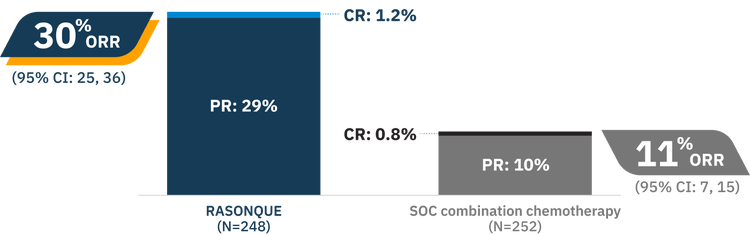
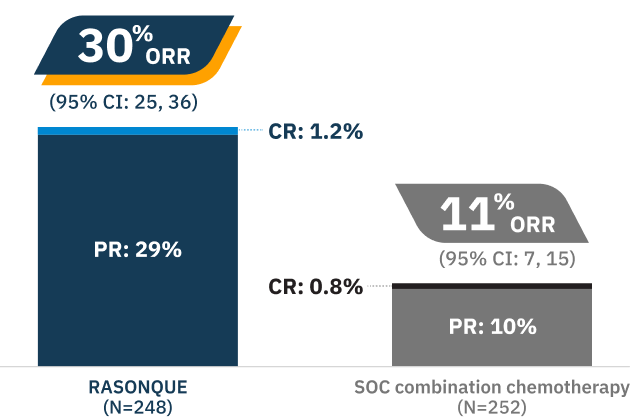
Objective response rate (ORR) was nearly tripled with RASONQUE1*

margin-bottom-sm
text-color-corazon
styled-text
A 19% difference in ORR was seen with RASONQUE vs SOC combination therapy (p<0.0001).1†
margin-bottom-lg
text-color-90-black
Secondary endpoint
ORR (ITT POPULATION)1
ORR was a secondary endpoint 1 in the ITT population: 30% ORR with RASONQUE (N=248) (95% CI: 25, 36.0) includes 1.2% CR and 29% PR. 11% ORR with SOC combination chemotherapy (N=252) (95% CI: 7, 15) includes 0.8% CR and 10% PR.
PINCH AND ZOOM
spacing-xl
callout-banner
without-image
RASONQUE delivered a clinically meaningful response across multiple measures3
background-color
gradient
styled-text

*Assessed by BICR in all randomized patients.1

Two-sided p-value based on stratified Cochran-Mantel-Haenszel chi-square test comparing response rate by BICR in patients with measurable disease by BICR at baseline.1

margin-top-lg
mobile-margin-top-15
text-color-90-black
styled-text
CR=complete response; PR=partial response.
margin-top-xs
mobile-margin-top-15
text-color-90-black
spacing-xl
spacing-xl
styled-text
Additional data from RASolute 302
margin-bottom-sm
text-color-denim-blue
styled-text

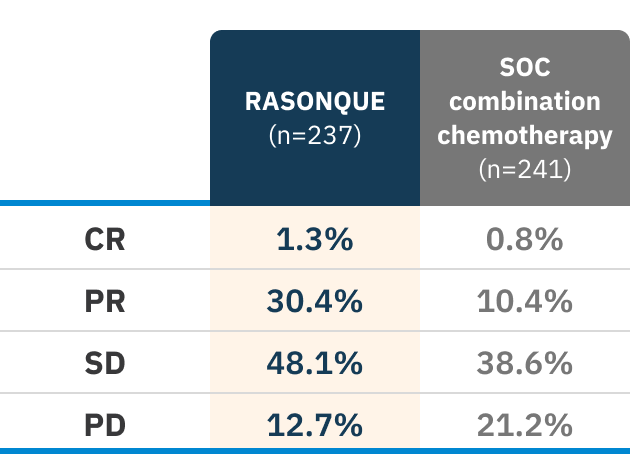
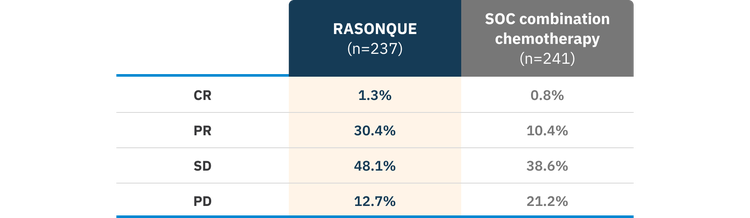
Individual best overall response3,15

margin-bottom-sm
text-color-corazon
styled-text
  • Median time to response was 1.9 months in both arms3*
margin-top-lg
margin-bottom-lg
mobile-margin-top-25
mobile-margin-bottom-40
text-color-denim-blue
row
PINCH & ZOOM
Individual best overall response1,14 for RASONQUE (n=237) and SOC combination chemotherapy (n=241) across complete response, partial response, stable disease, and progressive disease
true
styled-text
  • Disease control rate (DCR) was 79.7% with RASONQUE and 49.8% with
SOC combination chemotherapy15

text-color-denim-blue
styled-text
Individual best overall response in patients with measurable disease. These data were not evaluated for statistical significance and are provided as descriptive clinical information only.
margin-top-lg
margin-bottom-sm
mobile-margin-top-20
mobile-margin-bottom-10
text-color-90-black
styled-text
SD, defined as neither sufficient tumor shrinkage to qualify for PR nor sufficient tumor increase to qualify for PD, is not a component of ORR and can reflect the natural progression of disease rather than a direct therapeutic effect. SD may not be directly correlated to efficacy outcomes, and no conclusions of statistical significance can be drawn.16
margin-bottom-sm
text-color-90-black
styled-text
Assessment of DCR was a post hoc analysis. DCR is defined as CR + PR + SD. DCR may not be directly correlated to efficacy outcomes, and no conclusions of statistical significance can be drawn.16
margin-bottom-sm
text-color-90-black
styled-text
*Earliest scans were conducted at Week 8; responses may have occurred prior to first scan.17
margin-top-lg
mobile-margin-top-15
text-color-90-black
styled-text
PD=progressive disease; SD=stable disease.
margin-top-xs
margin-bottom-none
mobile-margin-top-15
text-color-90-black
spacing-xl
spacing-xl
styled-text
Additional data from RASolute 302
margin-top-none
margin-bottom-sm
text-color-denim-blue
styled-text
margin-bottom-sm
text-color-corazon
column
PINCH & ZOOM
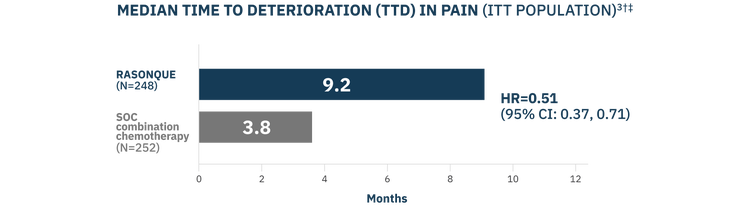
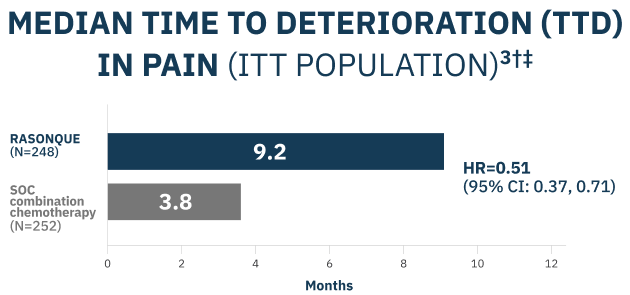
Median time to deterioration (TTD) in pain in the ITT population^2 dagger double dagger: 9.2 months with RASONQUE (N=248) and 3.8 months with SOC combination chemotherapy (N=252) HR=0.51 (95% CI: 0.37, 0.71).
false
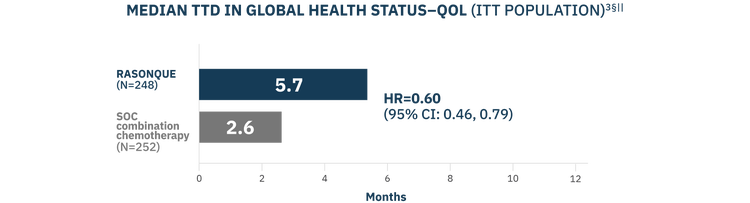
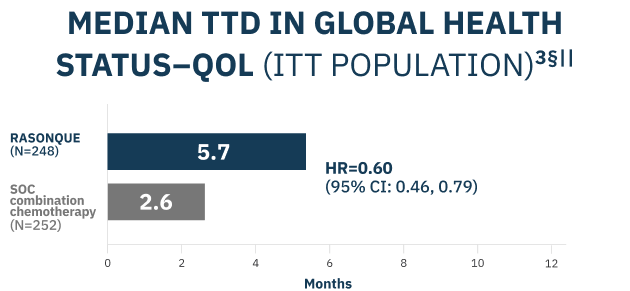
Median TTD in global health status–QOL in the ITT population^ 2 section mark parallel lines: 5.7 months with RASONQUE (N=248) and 2.6 months with SOC combination chemotherapy (N=252) HR=0.60 (95% CI: 0.46, 0.79).
true
styled-text
These results should be interpreted with caution due to the open-label design of the study. In addition, time-to-event PRO endpoints can be challenging to interpret due to factors such as defining deterioration, accounting for intercurrent events, and potential missing data.
margin-top-md
mobile-margin-top-20
text-color-90-black
styled-text
TTD in global health status (from EORTC QLQ-C30) and in pain (from EORTC QLQ-PAN26) were powered prespecified endpoints.3 Note that other domains of the 2 tools were not powered endpoints.
margin-top-sm
text-color-90-black
styled-text

*PROs questionnaires (EORTC QLQ-C30 and EORTC QLQ-PAN26) were completed in person on Day 1 of each cycle and at the end of treatment.17

The EORTC QLQ-PAN26 assesses symptoms related to pancreatic cancer, including pain, dietary changes, jaundice, altered bowel habit, emotional problems related to pancreatic cancer, and other symptoms (cachexia, indigestion, flatulence, dry mouth, taste changes).17,18

TTD in clinically relevant symptom of pain is defined as the time from randomization to the first occurrence of an increase of ≥10 points from baseline in corresponding pain scale or death, whichever occurs first, in the EORTC QLQ-PAN26 pain scale.3

§The EORTC QLQ-C30 incorporates 5 functional scales (physical, role, cognitive, emotional, and social), 3 symptom scales (fatigue, pain, and nausea and vomiting), a global health status–QoL scale, a number of single items assessing additional symptoms commonly reported by cancer patients (dyspnea, loss of appetite, insomnia, constipation, and diarrhea), and perceived financial impact of the disease.17,18

||TTD in global health status–QoL is defined as the time from randomization to the first occurrence of clinically relevant deterioration of global QoL score as defined by a decrease of ≥10 points from baseline, or death, whichever occurs first, in EORTC QLQ-C30.3

margin-top-lg
mobile-margin-top-20
text-color-90-black
spacing-xl
spacing-xs
spacing-sm
styled-text
5-FU=5-fluorouracil; BICR=blinded independent central review; CI=confidence interval; ECOG PS=Eastern Cooperative Oncology Group performance status; EORTC QLQ-C30=European Organization for Research and Treatment of Cancer Quality of Life Questionnaire-Core 30; EORTC QLQ-PAN26=European Organization for Research and Treatment of Cancer Quality of Life Questionnaire Pancreatic Cancer Module; FOLFOX=leucovorin + 5-FU + oxaliplatin; HR=hazard ratio; ITT=intent-to-treat; mFOLFIRINOX=modified leucovorin + 5-FU + irinotecan + oxaliplatin; mOS=median overall survival; mPFS=median progression-free survival; NE=not estimable; PFS=progression-free survival; PRO=patient-reported outcome; QoL=quality of life; RAS=rat sarcoma; SOC=standard of care.
margin-top-none
mobile-margin-top-none
text-color-90-black
spacing-lg
mobile-spacing-lg
styled-text
References:  1.  RASONQUE. Prescribing information. Revolution Medicines, Inc.; 2026.  2.  Katayama ES, Hue JJ, Bajor DL, et al. A comprehensive analysis of clinical trials in pancreatic cancer: what is coming down the pike? Oncotarget. 2020;11(38):3489-3501. doi:10.18632/oncotarget.27727 3. O’Reilly EM, Wainberg ZA, Hendifar AE, et al; RASolute 302 Trial Investigators. Daraxonrasib or chemotherapy in previously treated metastatic pancreatic cancer. N Engl J Med. Published online May 31, 2026. doi:10.1056/NEJMoa2605555  4.  Wainberg ZA, Melisi D, Macarulla T, et al. NALIRIFOX versus nab-paclitaxel and gemcitabine in treatment-naive patients with metastatic pancreatic ductal adenocarcinoma (NAPOLI 3): a randomised, open-label, phase 3 trial. Lancet. 2023;402(10409):1272-1281. doi:10.1016/S0140-6736(23)01366-1  5.  Von Hoff DD, Ervin T, Arena FP, et al. Increased survival in pancreatic cancer with nab-paclitaxel plus gemcitabine. N Engl J Med. 2013;369(18):1691-1703. doi:10.1056/NEJMoa1304369  6.  Conroy T, Desseigne F, Ychou M, et al; Groupe Tumeurs Digestives of Unicancer; PRODIGE Intergroup. FOLFIRINOX versus gemcitabine for metastatic pancreatic cancer. N Engl J Med. 2011;364(19):1817-1825. doi:10.1056/NEJMoa1011923  7.  Philip PA, Sahai V, Bahary N, et al. Devimistat (CPI-613) with modified fluorouarcil, oxaliplatin, irinotecan, and leucovorin (FFX) versus FFX for patients with metastatic adenocarcinoma of the pancreas: the phase III AVENGER 500 study. J Clin Oncol. 2024;42(31):3692-3701. doi:10.1200/JCO.23.02659  8.  Tempero M, Oh D-Y, Tabernero J, et al. Ibrutinib in combination with nab-paclitaxel and gemcitabine for first-line treatment of patients with metastatic pancreatic adenocarcinoma: phase III RESOLVE study. Ann Oncol. 2021;32(5):600-608. doi:10.1016/j.annonc.2021.01.070  9.  Bekaii-Saab T, Okusaka T, Goldstein D, et al. Napabucasin plus nab-paclitaxel with gemcitabine versus nab-paclitaxel with gemcitabine in previously untreated metastatic pancreatic adenocarcinoma: an adaptive multicentre, randomised, open-label, phase 3, superiority trial. EClinicalMedicine. 2023;58:101897. doi:10.1016/j.eclinm.2023.101897  10.  Van Cutsem E, Tempero MA, Sigal D, et al; HALO 109-301 Investigators. Randomized phase III trial of pegvorhyaluronidase alfa with nab-paclitaxel plus gemcitabine for patients with hyaluronan-high metastatic pancreatic adenocarcinoma. J Clin Oncol. 2020;38(27):3185-3196. doi:10.1200/JCO.20.00590  11.  Hecht JR, Lonardi S, Bendell J, et al. Randomized phase III study of FOLFOX alone or with pegilodecakin as second-line therapy in patients with metastatic pancreatic cancer that progressed after gemcitabine (SEQUOIA). J Clin Oncol. 2021;39(10):1108-1118. doi:10.1200/JCO.20.02232  12.  Wang-Gillam A, Li C-P, Bodoky G, et al; NAPOLI-1 Study Group. Nanoliposomal irinotecan with fluorouracil and folinic acid in metastatic pancreatic cancer after previous gemcitabine-based therapy (NAPOLI-1): a global, randomised, open-label, phase 3 trial. Lancet. 2016;387(10018):545-557. doi:10.1016/S0140-6736(15)00986-1  13.  De La Fouchardière C, Malka D, Cropet C, et al. Gemcitabine and paclitaxel versus gemcitabine alone after 5-fluorouracil, oxaliplatin, and irinotecan in metastatic pancreatic adenocarcinoma: a randomized phase III PRODIGE 65-UCGI 36-GEMPAX UNICANCER study. J Clin Oncol. 2024;42(9):1055-1066. doi:10.1200/JCO.23.00795  14.  Hammel P, Metges J-P, Mercade TM, et al. TRYBECA-1: a randomized phase III study of eryaspase combined with chemotherapy versus chemotherapy as second-line treatment in patients with advanced pancreatic adenocarcinoma. J Clin Oncol. 2025;43(35):3714-3727. doi:10.1200/JCO-25-00872  15.  Supplement to: O’Reilly EM, Wainberg ZA, Hendifar AE, et al; RASolute 302 Trial Investigators. Daraxonrasib or chemotherapy in previously treated metastatic pancreatic cancer. N Engl J Med. Published online May 31, 2026. doi:10.1056/NEJMoa2605555  16.  Villaruz LC, Socinski MA. The clinical viewpoint: definitions, limitations of RECIST, practical considerations of measurement. Clin Cancer Res. 2013;19(10):2629-2636. doi:10.1158/1078-0432.CCR-12-2935  17.  Protocol for: O’Reilly EM, Wainberg ZA, Hendifar AE, et al; RASolute 302 Trial Investigators. Daraxonrasib or chemotherapy in previously treated metastatic pancreatic cancer. N Engl J Med. Published online May 31, 2026. doi:10.1056/NEJMoa2605555  18.  Aaronson NK, Ahmedzai S, Bergman B, et al. The European Organisation for Research and Treatment of Cancer QLQ-C30: a quality-of-life instrument for use in international clinical trials in oncology. J Natl Cancer Inst. 1993;85:365-376.
text-color-90-black
spacing-xl
mobile-spacing-xl