NOW APPROVED


Efficacy
RASONQUE (daraxonrasib) demonstrated unprecedented improvements in OS and PFS vs SOC combination chemotherapy.1
Unprecedented overall survival (OS) was observed in patients, regardless of RAS mutation status1,3
Primary endpoints1,2
Secondary endpoint1
![OS was a secondary endpoint 1 in the ITT population: 13.2 months median OS with RASONQUE (95% CI: 10.0, NE) versus 6.7 months median OS with SOC combination chemotherapy (95% CI: 5.8, 8.0). 60% reduction in the risk of death (HR=0.40 [95% CI: 0.30, 0.53]^dagger; p<0.0001^double dagger).](./media_1dd139c43850017335680df8598167594ecf53bf0.png?width=750&format=png&optimize=medium)

![OS was a secondary endpoint 1 in the ITT population: 13.2 months median OS with RASONQUE (95% CI: 10.0, NE) versus 6.7 months median OS with SOC combination chemotherapy (95% CI: 5.8, 8.0). 60% reduction in the risk of death (HR=0.40 [95% CI: 0.30, 0.53]^dagger; p<0.0001^double dagger).](./media_135b27ddb1b3d52b8343b0627f7f2a02644b602e6.png?width=750&format=png&optimize=medium)


More than half of patients receiving RASONQUE were still alive at 12 months2§
At the time of data cutoff (February 10, 2026), 105 patients (42.3%) continued to receive RASONQUE and 35 (13.9%) continued to receive SOC combination chemotherapy.2
*SOC combination chemotherapy included mFOLFIRINOX, gemcitabine + nab-paclitaxel, FOLFOX, or liposomal irinotecan + 5-FU/leucovorin.1
†Based on the stratified Cox proportional hazard model.1
‡Two-sided p-value based on stratified log-rank test.1
§The 12-month OS was 53.2% in the RASONQUE group and 17.3% in SOC combination chemotherapy group.2
||As of May 31, 2026.2
OS results across prespecified subgroups14
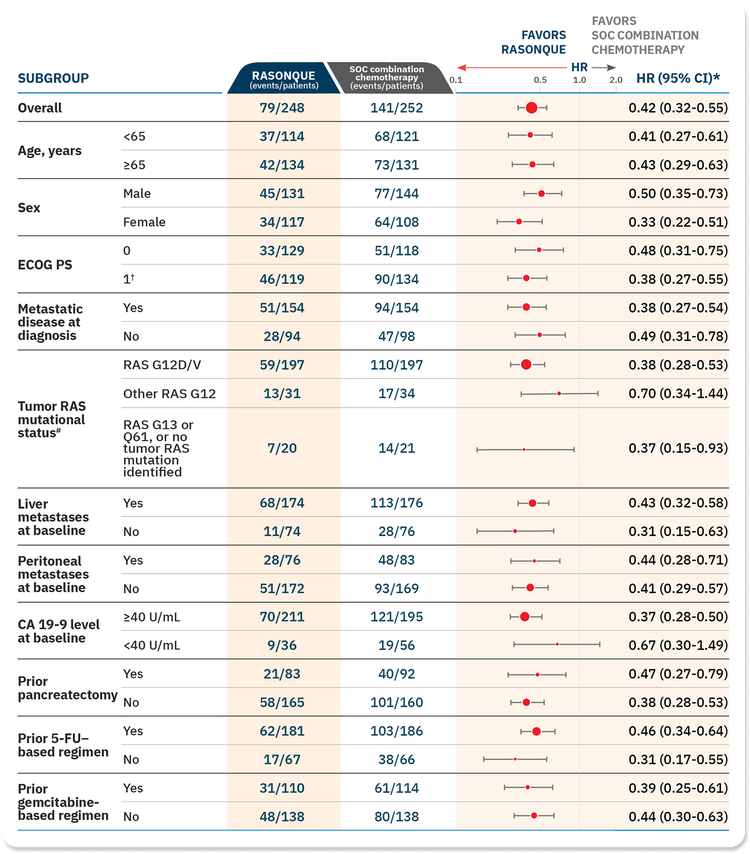
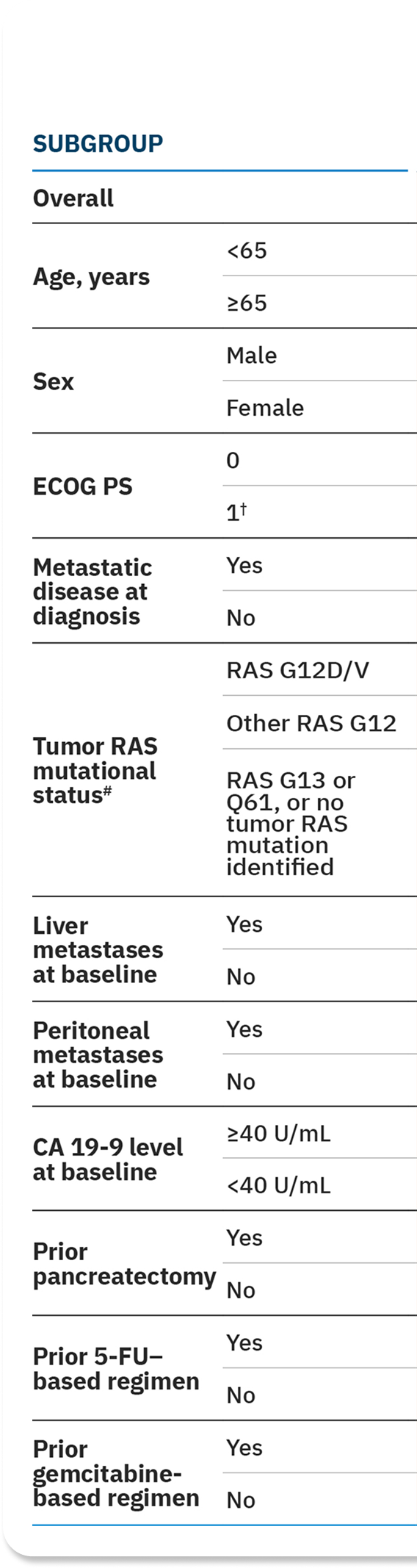
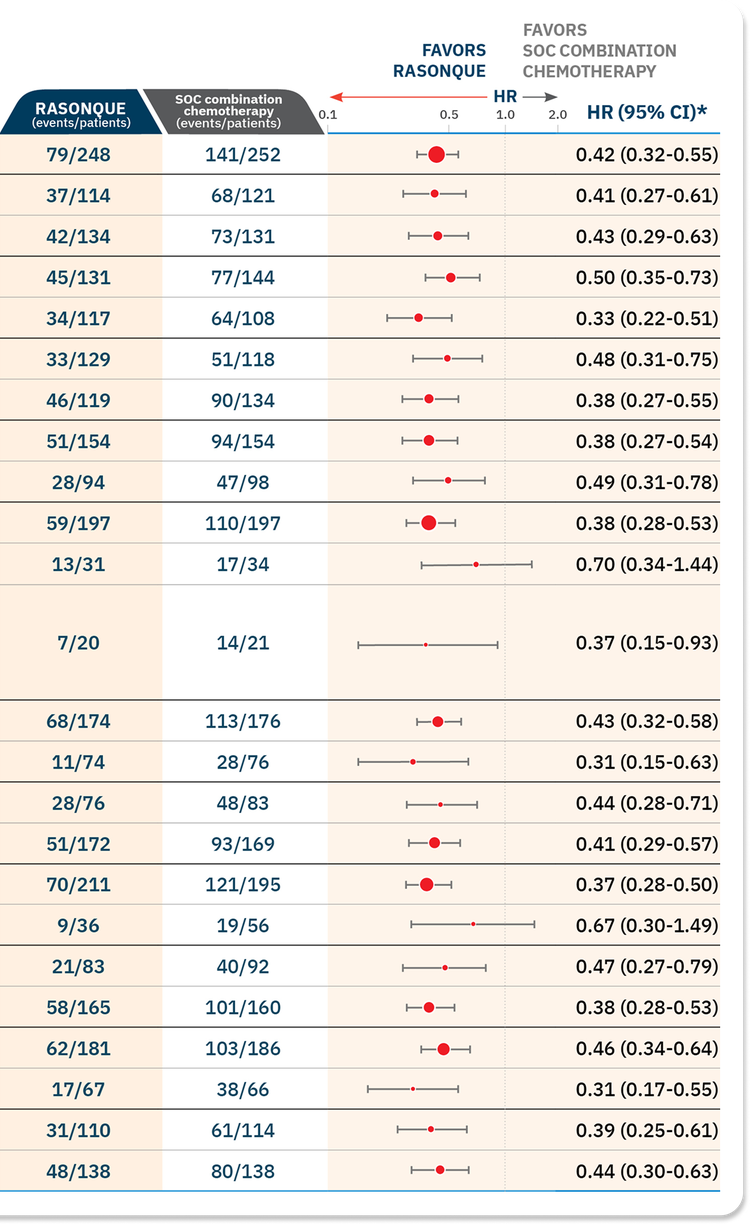
*HRs and 95% CIs were based on the stratified Cox model with Efron’s method of tie handling.14
†Three patients (including 2 patients randomized to the RASONQUE arm and 1 patient randomized to the chemotherapy arm) had ECOG PS >1 at baseline. These patients were not dosed due to no longer meeting trial eligibility criteria.14
‡Nine patients in the RASONQUE group and 7 patients in the chemotherapy group had no identified RAS mutation.2
mPFS was doubled with RASONQUE1
More than half of patients receiving RASONQUE were still alive and progression free at 6 months2*
Secondary endpoint1
![PFS was a secondary endpoint 1 in the ITT population: 7.2 months median PFS with RASONQUE (95% CI: 5.7, 7.5) versus 3.6 months median PFS with SOC combination chemotherapy (95% CI: 2.9, 4.2). 51% reduction in the risk of disease progression or death (HR=0.49 [95% CI: 0.38, 0.64]^dagger; p<0.0001^double dagger).](./media_1183a18cb980e72bcc8b644cb7bb12c53c90ce1fe.png?width=750&format=png&optimize=medium)

![PFS was a secondary endpoint 1 in the ITT population: 7.2 months median PFS with RASONQUE (95% CI: 5.7, 7.5) versus 3.6 months median PFS with SOC combination chemotherapy (95% CI: 2.9, 4.2). 51% reduction in the risk of disease progression or death (HR=0.49 [95% CI: 0.38, 0.64]^dagger; p<0.0001^double dagger).](./media_1e715261cb1e416d268b801a8699fc45aca43577d.png?width=750&format=png&optimize=medium)

*The 6-month PFS was 56.0% in the RASONQUE group and 32.9% in the SOC combination chemotherapy group.2
†Based on the stratified Cox proportional hazard model.1
‡Two-sided p-value based on stratified log-rank test.1
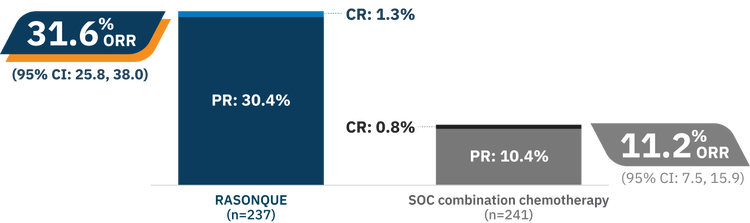
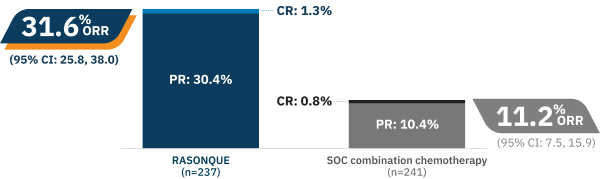
Objective response rate (ORR) was nearly tripled with RASONQUE1*
Secondary endpoint1
-
Median time to response was 1.9 months in both arms1
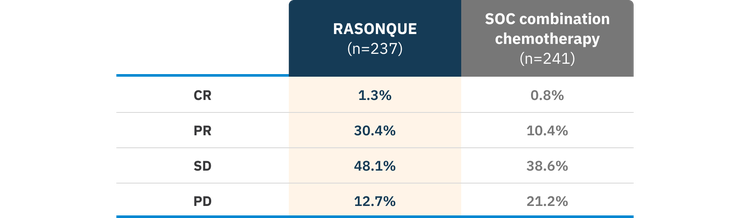
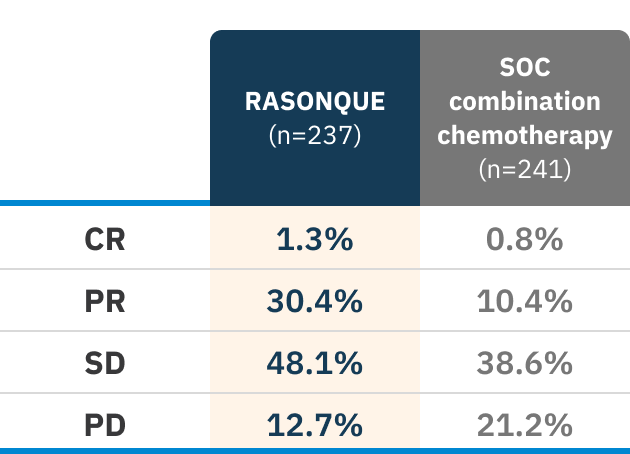
Individual best overall response1,14
-
Disease control rate (DCR) was 79.7% with RASONQUE and 49.8% with SOC combination chemotherapy1,14
Patient-reported outcomes: Health-related QoL2*
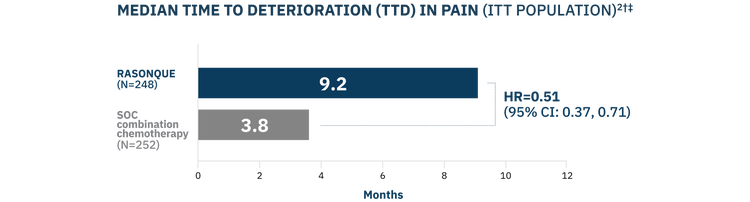
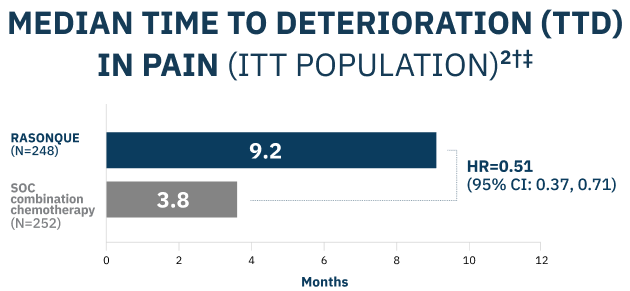
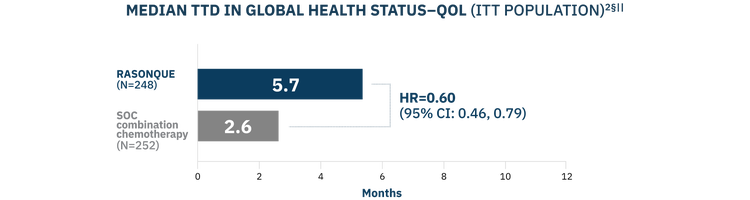
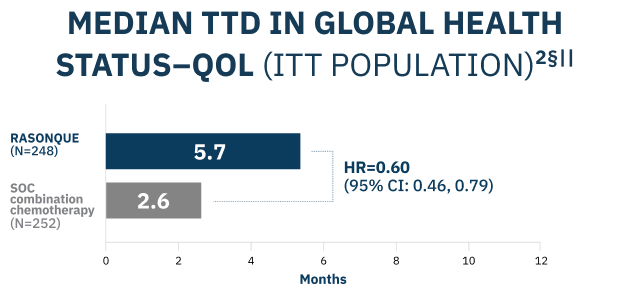
*PROs questionnaires (EORTC QLQ-C30 and EORTC QLQ-PAN26) were completed in person on Day 1 of each cycle and at the end of treatment.16
†The EORTC QLQ-PAN26 assesses symptoms related to pancreatic cancer, including pain, dietary changes, jaundice, altered bowel habit, emotional problems related to pancreatic cancer, and other symptoms (cachexia, indigestion, flatulence, dry mouth, taste changes).16,17
‡TTD in clinically relevant symptom of pain is defined as the time from randomization to the first occurrence of an increase of ≥10 points from baseline in corresponding pain scale or death, whichever occurs first, in the EORTC QLQ-PAN26 pain scale.2
§The EORTC QLQ-C30 incorporates 5 functional scales (physical, role, cognitive, emotional, and social), 3 symptom scales (fatigue, pain, and nausea and vomiting), a global health status–QoL scale, a number of single items assessing additional symptoms commonly reported by cancer patients (dyspnea, loss of appetite, insomnia, constipation, and diarrhea), and perceived financial impact of the disease.16,17
||TTD in global health status–QoL is defined as the time from randomization to the first occurrence of clinically relevant deterioration of global QoL score as defined by a decrease of ≥10 points from baseline, or death, whichever occurs first, in EORTC QLQ-C30.2