
NOW APPROVED

hero-secondary
A ship breaks through icebergs that reflect the many challenges in treating mPDAC and targeting RAS.

Trial design

RASolute 302 was a Phase 3 trial evaluating the efficacy and safety of RASONQUE monotherapy vs SOC combination chemotherapy in adults with previously treated metastatic pancreatic adenocarcinoma.1,2

spacing-xl
styled-text

RASolute 302: Evaluating the first and only approved RAS(ON) multi-selective inhibitor vs SOC combination chemotherapy1

margin-bottom-sm
text-color-corazon
styled-text
RASolute 302 was a global, randomized, head-to-head, open-label, Phase 3 trial evaluating the efficacy and safety of RASONQUE monotherapy vs SOC combination chemotherapy in adult patients with metastatic pancreatic adenocarcinoma who had received at least 1 prior systemic therapy.1,2
margin-top-none
margin-bottom-lg
text-color-90-black
styled-text
Key eligibility criteria1
margin-top-none
margin-bottom-sm
mobile-margin-bottom-20
text-color-denim-blue
styled-text
  • Confirmed metastatic pancreatic adenocarcinoma
  • Documented RAS status (mutant or wild-type)*
  • Disease progression after 1 previous line of systemic therapy
  • ECOG PS of 0 or 1
margin-top-none
margin-bottom-sm
mobile-margin-bottom-20
text-color-90-black
styled-text
Key exclusion criteria2
margin-top-none
margin-bottom-sm
mobile-margin-bottom-20
text-color-denim-blue
styled-text
  • Known CNS metastases
  • Previous RAS-targeted therapy
margin-top-none
margin-bottom-sm
mobile-margin-bottom-20
text-color-90-black
styled-text
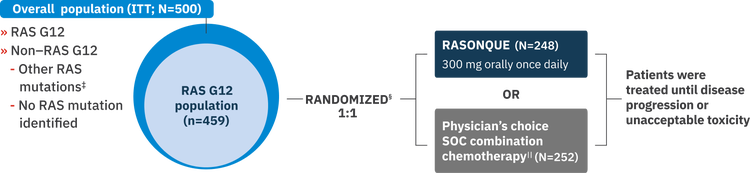
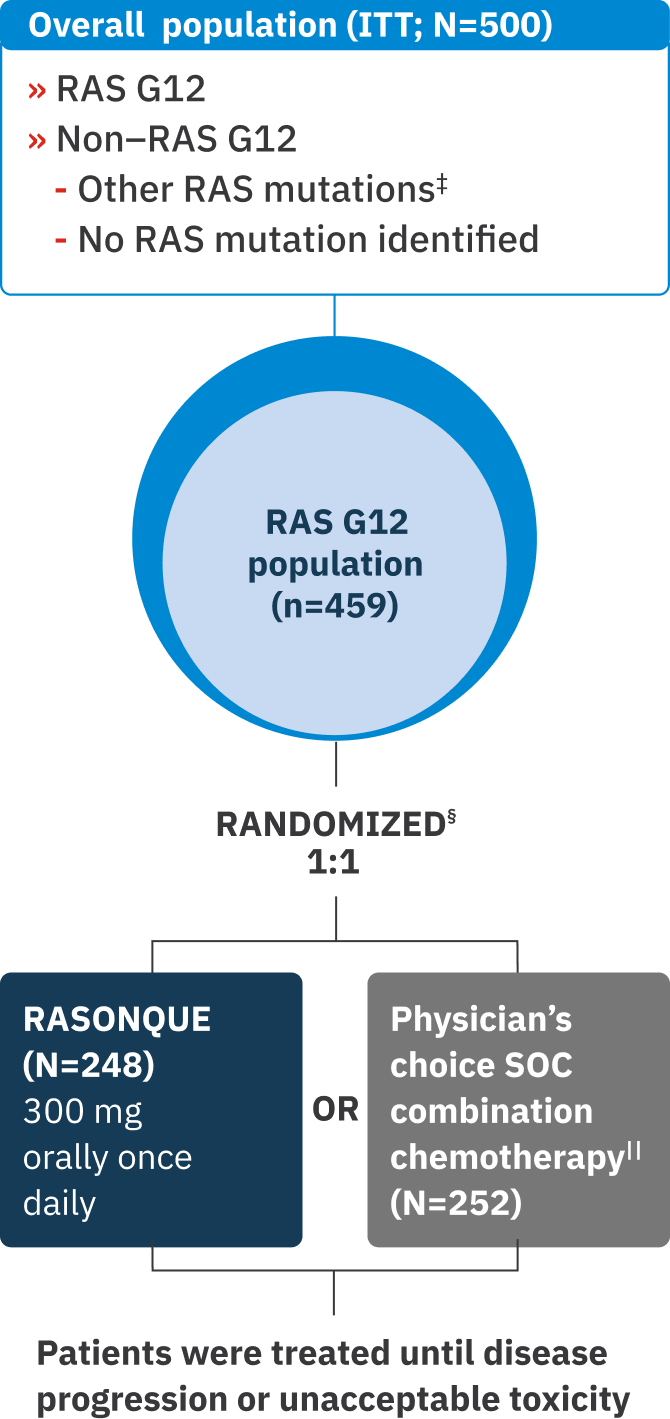
Study populations and treatment arms1
margin-top-none
margin-bottom-sm
mobile-margin-bottom-20
text-color-denim-blue
graphic
Overall population (ITT; N=500) includes the RAS G12 population (n=459) and non–RAS G12 (other RAS mutations double dagger and no RAS mutation identified). Patients were randomized section mark 1:1. Patients received either RASONQUE, 300 mg orally once daily (N=248), or physician’s choice of SOC combination chemotherapy parallel lines (N=252). Patients were treated until disease progression or unacceptable toxicity.
styled-text
Primary endpoints1
margin-top-sm
margin-bottom-sm
text-color-denim-blue
styled-text
RAS G12 population
margin-top-none
margin-bottom-xs
text-color-90-black
styled-text
  • Overall survival (OS)
  • Progression-free survival (PFS)
margin-top-none
margin-bottom-lg
text-color-90-black
styled-text
Select secondary endpoints1,2
margin-top-none
margin-bottom-sm
text-color-denim-blue
Overall population (ITT)
  • OS
  • PFS
RAS G12 population and overall population (ITT)
  • Objective response rate (ORR)#

  • Safety, including adverse reactions (ARs)

  • Time to response (TTR)#

  • Patient-reported outcomes (PROs)**

    • Time to deterioration (TTD) in pain
    • TTD in global health status
spacing-md

See the efficacy

styled-text

*RAS mutation status was determined by a locally available test using archival tumor tissue or circulating tumor DNA.1,3

A fluoropyrimidine-based or gemcitabine-based regimen in the metastatic setting or in the neoadjuvant or adjuvant setting if metastatic disease was diagnosed <6 months after the last dose.2

Included KRAS, NRAS, and HRAS mutations at positions G13 or Q61.2

§Randomization was stratified by RAS mutation status (RAS G12D/V mutation, other RAS G12 mutation, or RAS G13 or Q61 mutation or no RAS mutation identified), liver metastases at baseline (present or absent), and ECOG PS at baseline (0 or 1).2

||SOC combination chemotherapy included mFOLFIRINOX, gemcitabine + nab-paclitaxel, FOLFOX, or liposomal irinotecan + 5-FU/leucovorin.1

Per RECIST v1.1, as assessed by BICR.2

#As assessed by BICR and by the investigator.3

**Defined as TTD as assessed on the basis of pain (time to an increase of ≥10 points from baseline in score on the EORTC QLQ-PAN26 pain scale or death, whichever occurred first) and TTD as assessed on the basis of global health status–QoL (time to a decrease of ≥10 points from baseline in score on the EORTC QLQ-C30 global health status–QoL scale or death, whichever occurred first) in the RAS G12 and overall populations.2

margin-top-lg
margin-bottom-none
text-color-90-black
spacing-xl
spacing-xl
styled-text
In RASolute 302
margin-top-none
margin-bottom-sm
text-color-denim-blue
styled-text

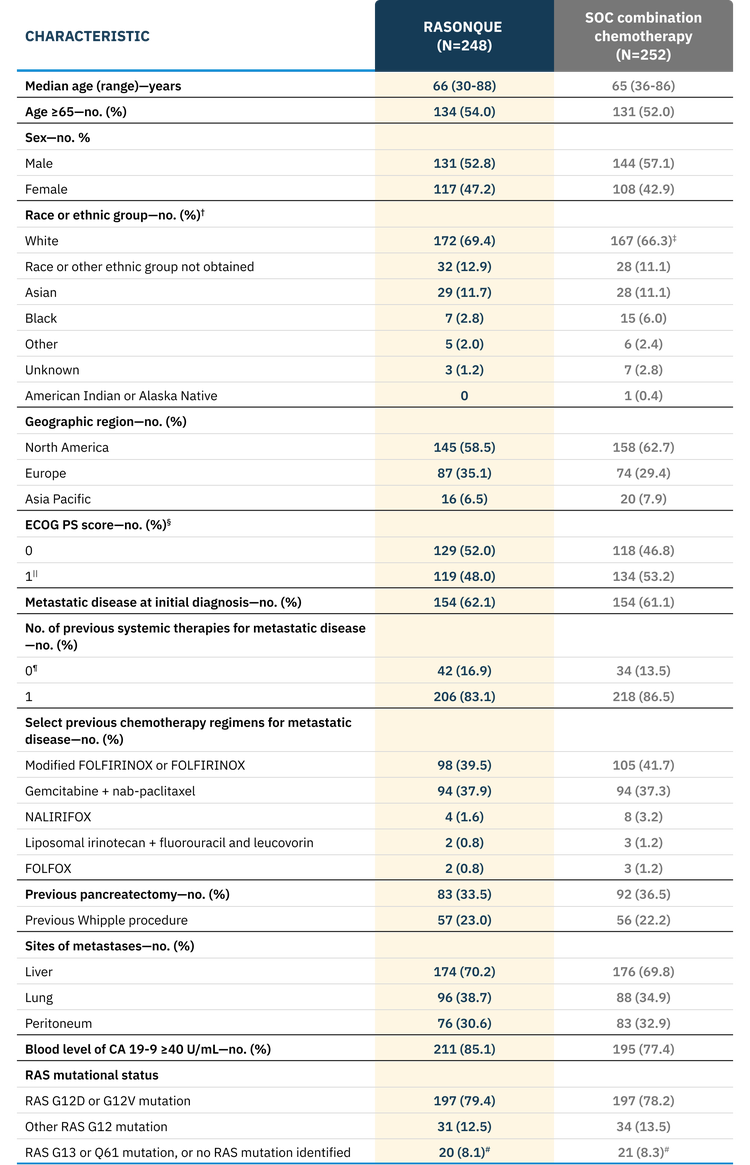
Patient characteristics were balanced across treatment arms2
margin-top-none
margin-bottom-sm
text-color-corazon
styled-text
OVERALL POPULATION (ITT)*
margin-top-none
margin-bottom-sm
text-color-denim-blue
graphic
Patient characteristics in the overall population (ITT).
styled-text

*The overall population was comprised of patients whose tumors harbored RAS mutations at G12, G13, or Q61, or patients in whom no RAS mutation was identified. Percentages may not total 100 because of rounding.2

Race and ethnic group were reported by the patients.2

The number of patients includes 1 patient whose race was documented as White and Asian.2

§ECOG PS scores range from 0 to 5, with higher scores indicating greater disability.2

||Three patients (2 randomly assigned to the RASONQUE group and 1 to the chemotherapy group) had an ECOG PS score higher than 1 at baseline; therefore, these patients no longer met the trial eligibility criteria and received no doses of the trial treatment.2

This category includes 42 patients (16.9%) in the RASONQUE group and 33 patients (13.1%) in the chemotherapy group who received previous treatment in the context of neoadjuvant or adjuvant disease but progressed to metastatic disease <6 months after the last dose of such therapy. One patient with a diagnosis of metastatic disease had a line of therapy that was incorrectly categorized as treatment for locally advanced disease.2

#Nine patients (3.6%) in the RASONQUE group and 7 patients (2.8%) in the SOC combination chemotherapy group had no identified RAS mutation. Eleven patients (4.4%) had RAS mutations at locations other than G12 (G13 or Q61) in the RASONQUE arm.2

margin-top-lg
mobile-margin-top-20
text-color-90-black
spacing-xl
spacing-xl
mobile-spacing-xl
spacing-sm
mobile-spacing-sm
styled-text
5-FU=5-fluorouracil; BICR=blinded independent central review; CA=carbohydrate antigen; CNS=central nervous system; DNA=deoxyribonucleic acid; ECOG PS=Eastern Cooperative Oncology Group performance status; EORTC QLQ-C30=European Organization for Research and Treatment of Cancer Quality of Life Questionnaire-Core 30; EORTC QLQ-PAN26=European Organization for Research and Treatment of Cancer Quality of Life Questionnaire Pancreatic Cancer Module; FOLFIRINOX=leucovorin + 5-FU + irinotecan + oxaliplatin; FOLFOX=leucovorin + 5-FU + oxaliplatin; HRAS=Harvey rat sarcoma; ITT=intent-to-treat; KRAS=Kirsten rat sarcoma; mFOLFIRINOX=modified leucovorin + 5-FU + irinotecan + oxaliplatin; NALIRIFOX=liposomal irinotecan + leucovorin + 5-FU + oxaliplatin; NRAS=neuroblastoma rat sarcoma; QoL=quality of life; RAS=rat sarcoma; RECIST=Response Evaluation Criteria in Solid Tumors; SOC=standard of care.
margin-top-none
margin-bottom-none
text-color-90-black
spacing-lg
mobile-spacing-lg
styled-text
References: 1. RASONQUE. Prescribing information. Revolution Medicines, Inc.; 2026. 2. O’Reilly EM, Wainberg ZA, Hendifar AE, et al; RASolute 302 Trial Investigators. Daraxonrasib or chemotherapy in previously treated metastatic pancreatic cancer. N Engl J Med. Published online May 31, 2026. doi:10.1056/NEJMoa2605555 3. Protocol for: O’Reilly EM, Wainberg ZA, Hendifar AE, et al; RASolute 302 Trial Investigators. Daraxonrasib or chemotherapy in previously treated metastatic pancreatic cancer. N Engl J Med. Published online May 31, 2026. doi:10.1056/NEJMoa2605555
text-color-90-black
spacing-xl
mobile-spacing-xl